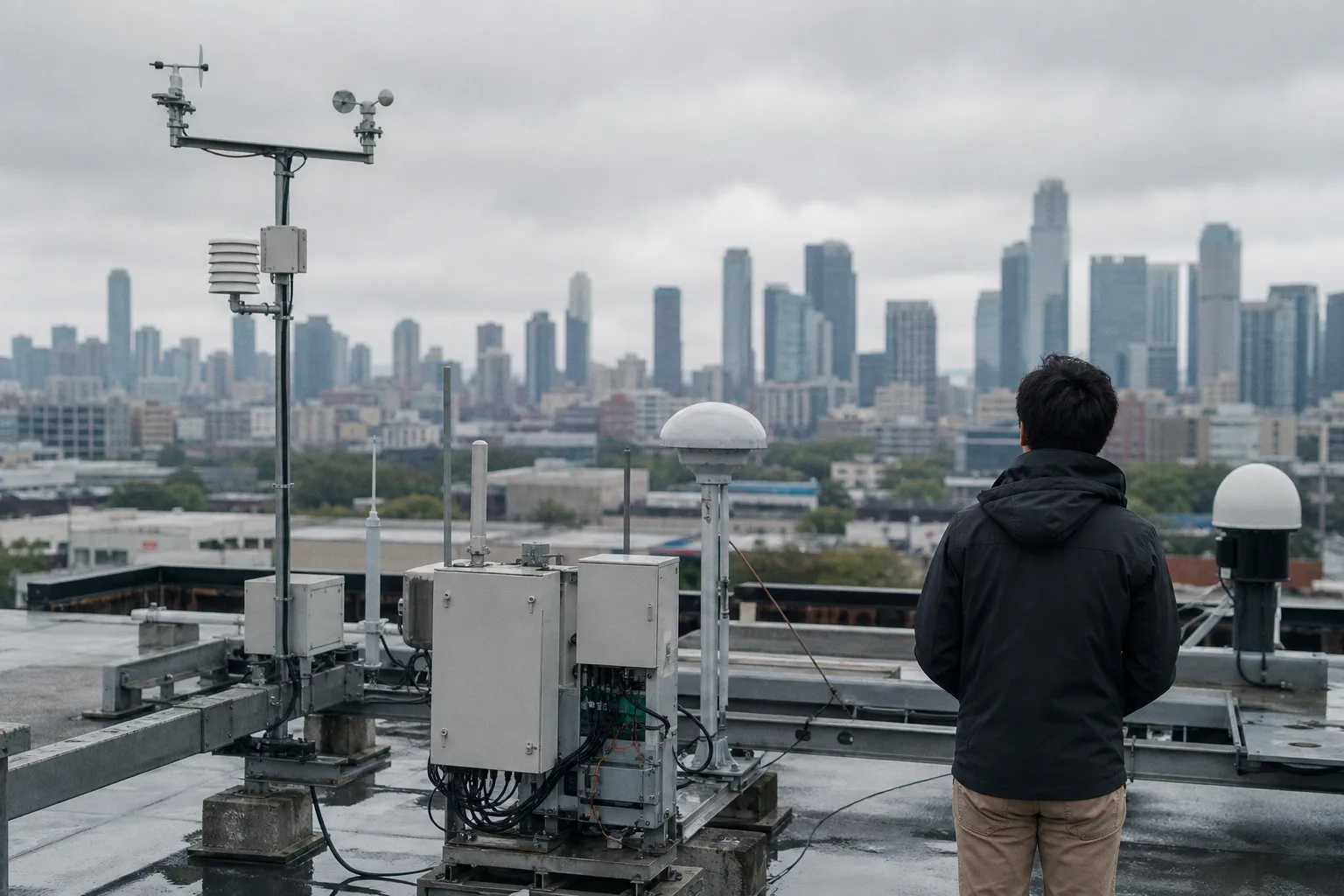
The payload: weather as a high-frequency input
The proposed flow is straightforward. Kweather feeds meteorological data — temperature, rainfall and other climate variables — into Flare’s Time Series Oracle. Flare’s role is verification: make the data independently auditable from the moment it is recorded, so smart contracts can treat it as an external input rather than a PDF report with latency.
That matters because weather finance is threshold logic. Not vibes. Not manual claims review.
A smart contract only needs a few deterministic pieces:
| Input | Contract use case |
|---|---|
| Temperature | heatwave triggers, energy exposure |
| Rainfall | drought or heavy-rain thresholds |
| Climate variables | agriculture, logistics, insurance models |
| Verified timestamped feed | audit trail for payout or settlement |
The companies say the pilot is aimed at publishing verified meteorological data on-chain and developing blockchain-based weather finance products. That phrasing is doing real work. “Publishing” is the feed problem. “Products” is the settlement problem. The gap between them is where oracle design either earns its fee or adds gas overhead for no reason.
Threshold markets need clean deviation rules
The obvious first target is parametric climate insurance: automated payouts when predefined environmental thresholds are met — drought, heatwaves, heavy rainfall. No traditional claims assessment. Just trigger condition, verified feed, execution path.
That is attractive, but also unforgiving. A weather feed is not a VWAP. There is no neat exchange tape. Node operators and data engineers should be asking the boring questions now:
- What is the update cadence for each variable?
- How are outliers handled before they hit the oracle?
- Where are deviation thresholds defined: source side, oracle side, or contract side?
- What happens when sensors disagree?
- Is the feed auditable enough for financial institutions and climate-sensitive industries?
The reported plan also includes weather derivatives for agriculture, energy, logistics and other sectors exposed to climate volatility. That moves the dataset into capital-markets territory. Once weather becomes collateral-adjacent, the tolerance for opaque data pipelines drops fast. Anyone who has watched fixed-income desks react to central-bank surprises — like a rate-hike fight spilling into bond-market assumptions — knows the pattern: when thresholds move money, inputs get litigated.
DePIN, RWAs, and the XRP footnote
The partnership may also explore combining Kweather’s physical meteorological infrastructure with blockchain networks to create a decentralized physical infrastructure network. Kweather’s data-driven revenue streams could be tokenized as real-world assets, according to the report.
That is the second-order angle. The first order is: can Flare turn weather observations into dependable oracle packets? The second order is: can the infrastructure producing those packets become financeable itself?
There is also a potential XRP integration. The companies may explore connecting the system to the XRP ecosystem through Flare’s existing asset and execution layers. Treat that as optional routing, not the core benchmark. The core benchmark is simpler: can temperature and rainfall data arrive on-chain with low enough latency, clear enough provenance, and tight enough auditability to support automated financial products?
For builders, the action item is not to mint a weather token. It is to model contracts around hard environmental thresholds and test failure modes: stale feed, missing observation, extreme outlier, disputed trigger. If this pilot advances, the winning integrations will be the ones with boring controls and clean execution paths. Weather finance will not be saved by narrative. It will be priced by data quality.