Verifiable computation: moving beyond blind oracle trust
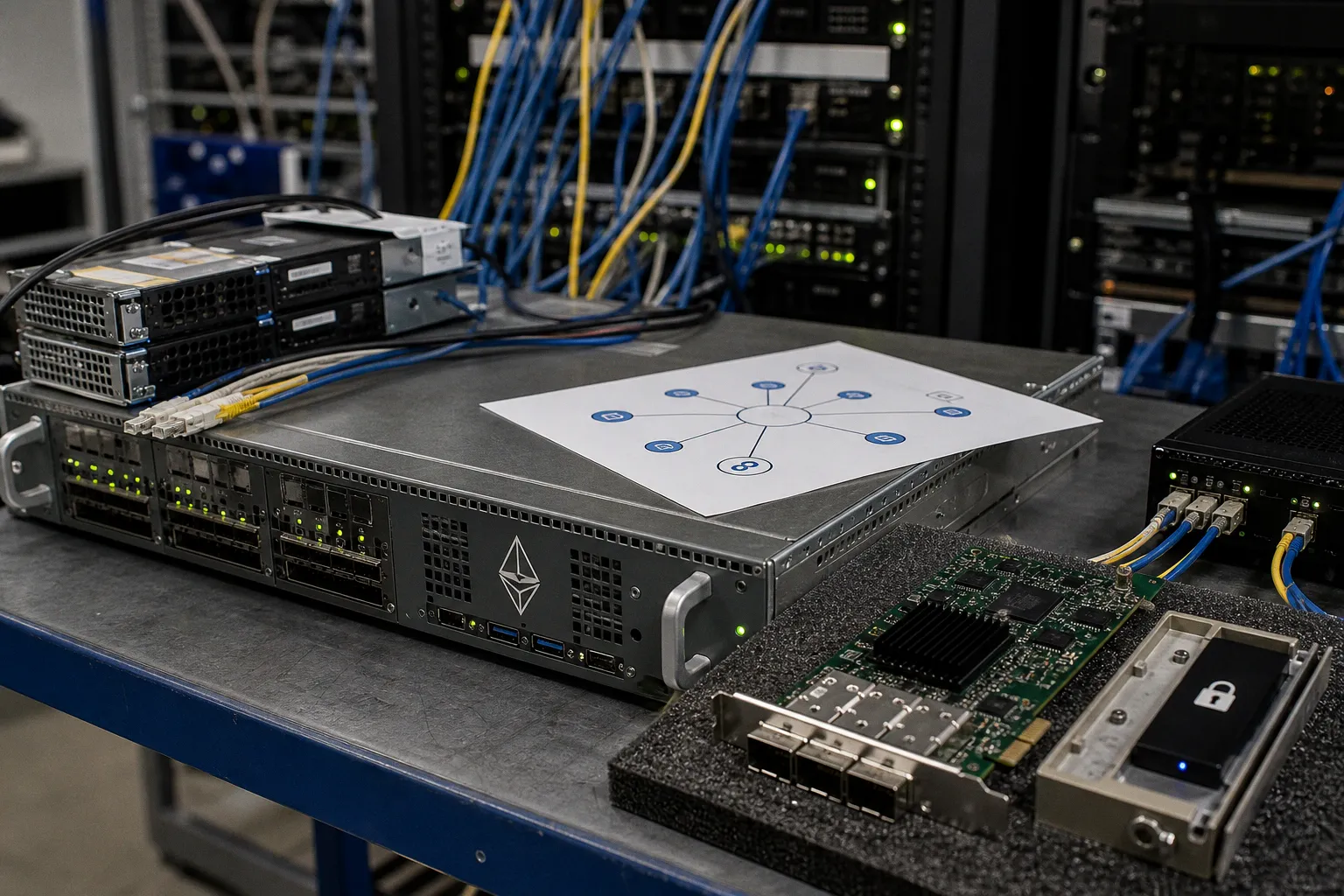
A zero knowledge proof attached to an oracle feed constitutes a verifiable computation primitive. The oracle node executes its aggregation logic — whether that logic implements a medianization across twenty sources, a volume-weighted average price (VWAP) calculation, or a more exotic combination algorithm — and produces both the data output and a cryptographic attestation that the output was generated according to a publicly specified program. The smart contract, or any independent verifier, can then confirm that the stated computation was performed correctly without re-executing it or trusting the operator's claims about its internal processes. This is the core architectural shift: the trust boundary migrates from a social agreement with an oracle provider to a mathematical verification of deterministic execution.
In a typical ZK-oracle integration, the lifecycle proceeds through distinct phases. First, the data aggregation logic is compiled into an arithmetic circuit (commonly expressed in domain-specific languages such as Circom, Noir, or Halo2). This circuit encodes every constraint the computation must satisfy: that the median was correctly computed over a declared set of inputs, that the timestamp falls within an acceptable freshness window, that the source identities match a registry commitment, and that no input values exceed sanity bounds. Second, the oracle node fetches raw data from external sources, applies the aggregation function, and generates a proof attesting that a witness satisfying all circuit constraints exists. Third, the proof, along with the public inputs and outputs, is submitted to an on-chain verifier contract. The verifier checks the proof against a verification key derived from a (typically one-time) trusted setup or, in the case of transparent setups like STARKs, a publicly verifiable set of parameters. If verification succeeds, the data is accepted; if it fails, the transaction reverts.
This architecture offers properties that crypto-economic oracle designs cannot. A crypto-economic oracle network relies on staked collateral, reputation systems, and slashable misbehavior to incentivize honest reporting. Its security is probabilistic and bounded by the value of stake relative to potential profit from manipulation. A ZK-oracle, by contrast, offers computational integrity guarantees that are absolute within the circuit's specification: either the stated aggregation logic was executed exactly as encoded, or no valid proof can be produced. The data source layer remains a separate problem — the proof verifies that the oracle processed inputs correctly, not that the inputs themselves were accurate reflections of ground truth — but the manipulation surface shrinks substantially.
A ZK-proof attached to an oracle feed converts a reputational assertion into a mathematical claim. The verifier does not ask whether the oracle is honest; it asks whether the proof checks out.
Mitigating oracle manipulation with cryptographic proofs
Oracle manipulation has historically exploited three vectors: data source compromise, aggregation logic exploitation, and latency-based front-running. Flash loan attacks, which became a defining vulnerability class after the 2022 market events targeting lending protocols, weaponized the third vector most effectively. An attacker would borrow massive amounts of capital without collateral, manipulate a thinly traded exchange price, and cause an oracle reading (delayed by block confirmation times or heartbeat intervals) to reflect an artificial value, triggering liquidations or enabling under-collateralized borrows.
ZK-proofs address the aggregation logic vector directly. A well-constructed circuit can enforce that the price computation follows a specific algorithm: for instance, that the median was computed over at least seven sources, that outlier removal was applied according to a declared threshold, and that the final value lies within a bounded range relative to a reference rate. The proof attests to these properties cryptographically. An oracle operator cannot substitute a different computation, omit sources, or manipulate the median calculation without invalidating the proof. The manipulation surface thus collapses to the data source layer — where the proof's guarantees end — and to the circuit specification itself.
Latency-based attacks present a subtler challenge. A proof attests to computation correctness at a moment in time; it does not, by itself, prove that the data was fresh when used. However, circuits can be designed to enforce freshness constraints. A proof can include a commitment to a recent block hash, a timestamp from a trusted source, or a signature from a sequencing service that attests the data was captured within a specified window. The verifier contract can check these auxiliary proofs against on-chain state, rejecting any oracle update that fails the freshness criterion. This is not a theoretical extension — implementations binding oracle freshness to consensus-layer attestations have been deployed as components of ZK-rollup architectures that rely on external price feeds for liquidations and synthetic asset settlements.
Data source compromise remains the residual risk. If an attacker controls a majority of the sources feeding into a medianization, the ZK-proof will dutifully attest that the median of those compromised sources was computed correctly. The proof system cannot verify that the sources themselves reported truthfully. This limitation must be addressed at the network topology layer: through diverse, independent data providers, through source authentication via digital signatures, and through economic mechanisms that make source compromise expensive. ZK-proofs do not eliminate the oracle manipulation problem; they bound it and relocate it to a layer where mitigation strategies are better understood.
The hidden risks of under-constrained ZK-circuits
The cryptographic guarantees of a ZK-oracle are only as strong as the circuit that encodes its aggregation logic. Under-constrained circuits represent the most insidious failure mode in ZK-proof systems. An under-constrained circuit is one in which the proof verification passes for inputs that do not actually satisfy the intended computation — the constraints fail to fully capture every property the developer believed they were enforcing. A proof generated against such a circuit is technically valid (it satisfies all stated constraints) but semantically meaningless (it does not prove what the developer thought it proved).
This failure mode is particularly dangerous because it is invisible from the outside. The verifier contract accepts the proof. The data is delivered. The state transition executes. Everything appears nominal until an attacker identifies the missing constraint and submits a witness that exploits the gap. In one well-documented class of vulnerabilities, a circuit intended to prove membership in a Merkle tree failed to enforce the correct path structure, allowing an attacker to construct a proof of inclusion for a leaf that was not actually in the tree. The on-chain verifier accepted it; the contract was drained.
Detecting under-constrained circuits requires expertise that sits at the intersection of cryptography, formal verification, and domain-specific knowledge of the application logic. Standard testing approaches — fuzzing, symbolic execution, even formal verification of the circuit code — can confirm that the constraints expressed in the circuit are consistent, but they cannot confirm that the constraints expressed in the circuit are the constraints the developer intended. That gap between specification and implementation is where audits must focus their attention. The audit process for a ZK-oracle must include an explicit review of the specification document alongside the circuit implementation, with line-by-line verification that every property in the specification has a corresponding constraint in the code.
An under-constrained circuit produces proofs that are mathematically valid and semantically vacuous. The verifier checks the proof; the proof checks nothing the developer believed it was checking.
Soundness bugs in the underlying proof system itself are rarer but carry catastrophic consequences. If the cryptographic assumptions underlying the proof system are broken — whether through advances in quantum computing that compromise elliptic curve pairings used in Groth16, through implementation bugs in trusted setup ceremonies, or through vulnerabilities in the prover software — every proof ever generated becomes suspect. The 2022 disclosure of a vulnerability in a popular proving library affected several deployed systems; the fallout demonstrated how concentrated the ecosystem's exposure to individual cryptographic libraries had become. A serious ZK audit must include a review of the prover implementation, the trusted setup parameters (if applicable), and the security posture of every dependency in the proof generation pipeline.
Why standard smart contract audits fail in ZK environments
The smart contract audit industry built its methodology around Solidity and the EVM execution model. Audit firms developed tools — Slither, Mythril, Echidna, Foundry's invariant testing — and heuristic checklists tuned to the specific failure modes of stateful, reentrancy-prone, gas-limited contract execution. These tools and methodologies are necessary but not sufficient when the contract system includes a ZK component. A Slither run against a verifier contract will confirm that the contract correctly calls the proof verification precompile, checks the return value, and handles reverts appropriately. It will not examine the circuit that generated the proof. It will not evaluate whether the constraints in the circuit match the specification. It will not detect a soundness bug in the proving system.
This methodological gap has produced a two-tier audit market. The first tier handles conventional smart contract logic: access control, reentrancy, integer overflow, gas griefing, oracle integration patterns. The second tier requires cryptographers with hands-on experience in circuit design, familiarity with the specific DSL being used (Circom, Noir, Halo2, Cairo), and the ability to reason about constraint systems at a mathematical level. The intersection of these two tiers is small. Most audit firms do not have in-house cryptographic expertise sufficient for rigorous ZK-circuit review; most cryptographic researchers do not have the operational context to evaluate how a circuit fits into a broader DeFi protocol's state machine.
The consequences have been visible in the marketplace. Audit reports on ZK-rollup and ZK-oracle projects increasingly include disclaimers that explicitly scope the audit to the contract layer and exclude the circuit implementation, or they include a separate cryptographic review conducted by a specialist firm. This bifurcation is a reasonable response to the skill gap, but it creates an accountability problem: the protocol team receives an audit report that says "the contracts are fine," and the cryptographic review says "the circuits are sound," but no single reviewer has examined the interface between them. The most dangerous bugs often live at that interface — in assumptions the circuit makes about on-chain state, in freshness windows the contract does not enforce, in trusted setup parameters the contract does not validate.
A protocol seeking rigorous ZK-oracle security must engage both tiers and, ideally, a third reviewer capable of evaluating the integration. The cost is significant. The alternative is accepting a compartmentalized risk model in which each component is audited by a specialist but the system as a whole is not.
Balancing proof generation time and on-chain verification costs
The economics of ZK-oracle deployment impose constraints that do not exist in conventional oracle architectures. Proof generation is computationally expensive: generating a Groth16 proof for a moderately complex circuit can take seconds to minutes on consumer hardware, and generating a STARK proof for a comparable circuit can take minutes to hours depending on the recursion strategy and hardware acceleration available. This latency is incompatible with oracle use cases that require sub-second price updates, such as derivatives exchanges with high-frequency liquidation triggers.
Several mitigation strategies have emerged. Proof recursion allows a complex circuit to be split into smaller sub-circuits whose proofs are recursively aggregated into a single final proof, reducing on-chain verification cost but not necessarily off-chain generation time. Hardware acceleration through FPGAs and ASICs can reduce proof generation latency by orders of magnitude, but it centralizes the oracle operation among actors who can afford the capital expenditure. Delegated proving — where the proof generation is outsourced to a specialized proving network — introduces a new trust assumption about the prover's honesty, though this can be partially mitigated through redundancy and economic staking.
On-chain verification cost is the more tractable problem. A Groth16 verification on Ethereum mainnet consumes approximately 200,000 to 300,000 gas, depending on the curve and precompile availability. STARK verification is more expensive but benefits from ongoing EIP improvements and L2 deployment contexts where gas costs are substantially lower. For oracle use cases that update infrequently (once per hour or once per day), the verification cost is acceptable. For high-frequency oracle updates, the cumulative gas cost becomes a meaningful component of the protocol's operational budget and must be priced into the oracle's fee structure.
| Parameter | Groth16-based ZK-oracle | STARK-based ZK-oracle | Conventional crypto-economic oracle |
|---|---|---|---|
| Proof generation time | Seconds to minutes | Minutes to hours | N/A (no proof) |
| On-chain verification cost | ~200–300k gas | Higher, L2-friendly | Lower (signature aggregation) |
| Trusted setup required | Yes (per circuit) | No (transparent) | No |
| Cryptographic assumption | Elliptic curve discrete log | Collision-resistant hash functions | Crypto-economic stake |
| Quantum resistance | No | Yes | Yes (if signatures are) |
The choice between proof systems is not purely technical. It involves trade-offs between trusted setup ceremony overhead and proof size, between proof generation latency and verification cost, between quantum resistance and ecosystem tooling maturity. For oracle applications where the data update cadence is measured in minutes, Groth16 remains a reasonable default. For applications requiring transparency (no trusted setup) or long-term quantum resistance, STARK-based systems carry meaningful advantages despite their higher computational footprint.
The viability of a ZK-oracle depends on whether the application can tolerate proof generation latency as a fixed cost in exchange for cryptographic integrity guarantees that crypto-economic designs cannot provide.
The audit checklist that does not exist yet
The industry lacks a standardized audit framework for ZK-oracle systems. Existing ZK audit guides — published by firms like CertiK, Consensys, and Immunefi — provide valuable starting points but remain informal documents rather than accepted industry standards. The challenge is not the absence of methodological thinking; it is the absence of agreed-upon scope boundaries, the rapid evolution of circuit DSLs and proving systems, and the small population of auditors with sufficient expertise to evaluate these systems at depth.
What a mature audit framework would need to include: a specification review phase that confirms the circuit constraints match the intended computation; a constraint completeness analysis that attempts to identify under-constrained variables; a soundness review of the proving system and its dependencies; an integration review that evaluates how the verifier contract handles proof failures, stale proofs, and replay attacks; and a freshness review that confirms the oracle data meets the application's latency requirements. Each of these phases requires different expertise and different tools. No single audit engagement currently covers all of them with equal rigor.
The protocols deploying ZK-oracles today are operating with a security model that is fundamentally stronger than crypto-economic oracle designs but fundamentally less mature in its audit methodology. The asymmetry will narrow as audit firms build cryptographic capability and as ZK-specific tools mature. Until then, protocol teams must accept that a ZK-oracle audit is not a single engagement but a composite of specialized reviews, each with its own scope, methodology, and limitations.
The architectural trajectory is clear: the next generation of oracle systems will treat cryptographic proofs as a baseline expectation rather than an exotic enhancement. The trust boundary between smart contracts and external data will continue to migrate from social trust to mathematical verification. Protocols that adopt ZK-oracle architectures early are accepting higher integration complexity and audit cost in exchange for security guarantees that will become industry standard within the next several years. That is a reasonable trade — for protocols whose value at risk justifies the engineering investment and whose update cadence accommodates the proof generation latency inherent in current ZK systems. For high-frequency applications with thin margins and tight latency budgets, conventional oracle architectures with comprehensive crypto-economic security remain the pragmatic choice. The binary assessment is this: ZK-proofs for oracle data are architecturally sound and cryptographically rigorous, but the audit ecosystem supporting them is not yet mature enough to treat their security claims with the same confidence as their mathematical foundations warrant.